Scientists may have found a way to track one of North America’s most elusive turtlesAndrei Ionescu Sun, November 22, 2026 at 9:37 PM UTC
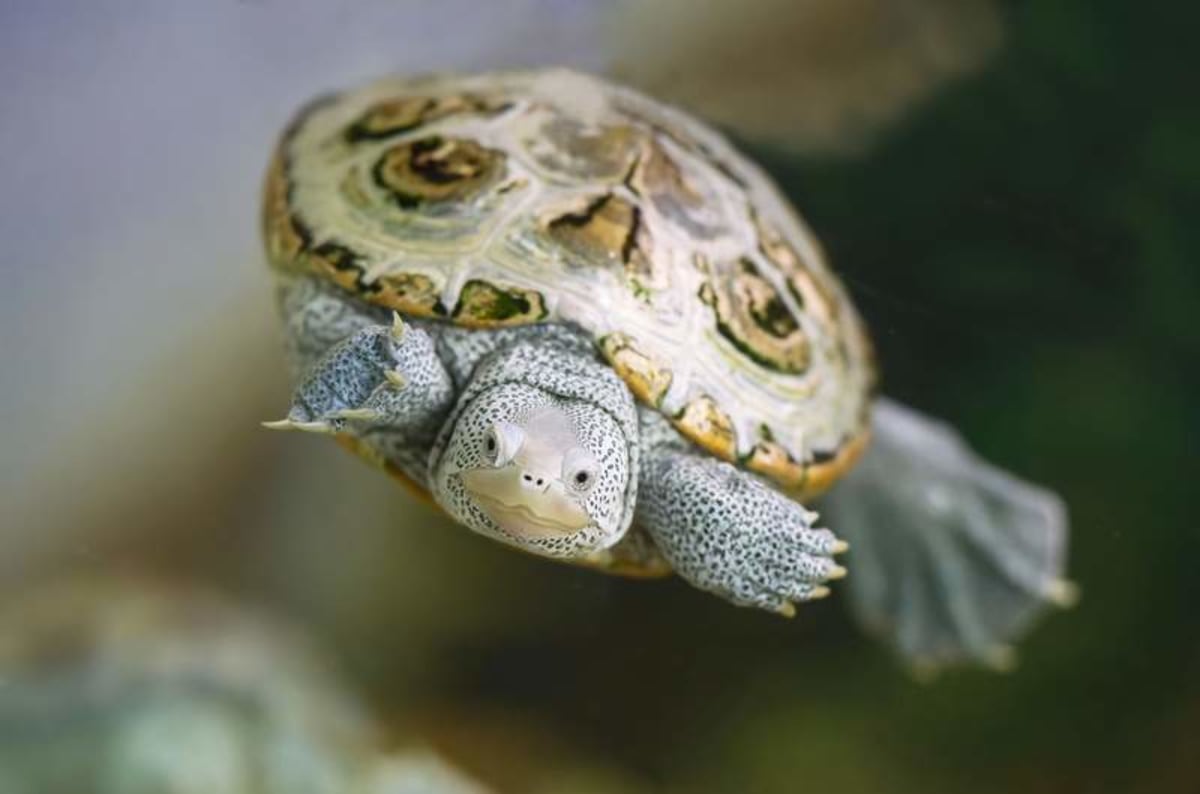
Diamondback terrapins inhabit the brackish waters of coastal salt marshes and estuaries. Credit: Shutterstock
Diamondback terrapins are hard to find and harder to count. A new study suggests that one of the best ways to follow them may be through a tiny flatworm that lives in their intestines and in the snails they eat.
By reading this parasite’s genes along the US Atlantic coast, scientists found that its populations split into distinct groups.
They also found a genetic dividing line about 300 kilometers south of where turtle experts had drawn the boundary between two terrapin subspecies.
The study was carried out by researchers from Florida Atlantic University’s Harbor Branch Oceanographic Institute and East Carolina University.
A turtle saved by Prohibition
The diamondback terrapin is the only North American turtle that lives exclusively in brackish water, in salt marshes and estuaries along the coast. For a long time, people mostly ate it.
Turtle soup was a fashionable dish, and hunting for it drove the species into steep decline until the early 20th century. Then, in 1920, Prohibition banned sherry, a key ingredient in most turtle soup recipes.
Demand collapsed, and so did the hunting.
That wasn’t a happy ending, though. Terrapins kept declining because of habitat loss, coastal development, and drowning in crab pots.
The species is now listed as “vulnerable” on the IUCN Red List. Conservationists want better data on where terrapin populations live and how they’re connected.
But the turtles are secretive and spread out, and catching enough to answer those questions is slow, expensive work.
A parasite with two homes
The parasite is a fluke called Pleurogonius malaclemys. It can’t complete its life without two hosts.
Its eggs pass out in terrapin droppings and are eaten by eastern mudsnails. Inside the snail, the fluke multiplies by cloning itself.
Its larvae then leave the snail’s soft body and form small pearly cysts on the hard plate the snail uses to seal its shell.
When a terrapin eats an infected snail, the fluke grows into an adult in the turtle’s gut and reproduces sexually there.
This arrangement is what makes the fluke useful. Mudsnails are abundant and easy to collect, and they barely move.
Terrapins are the ones that carry the parasite from marsh to marsh. If the turtles don’t travel, the fluke’s genes don’t travel either. In principle, the parasite’s family tree should trace the turtle’s movements.
“One of the biggest challenges in conserving vulnerable species is understanding how populations are distributed and connected without having to capture and handle large numbers of animals,” said senior author Michael McCoy from FAU Harbor Branch.
“Our findings show that this parasite may provide an important window into the ecology of diamondback terrapins.”
Thousands of snails under the microscope
The team collected mudsnails from Cape Cod in Massachusetts to St. Augustine in Florida and dissected more than 4,000 of them. Infections inside the snails were rare, never reaching 4% at any site.
The cysts outside were far more common, appearing on as many as 74% of snails at some marshes. Altogether, the fluke turned up at 23 of the 29 marshes sampled.
Finds on Cape Cod and in northeast Florida pushed its known range further north and south.
The Wetlands Institute provided the researchers with 38 female terrapins that had been killed by cars in New Jersey.
Seventeen of them carried adult flukes, with up to seven worms per turtle.
What the DNA revealed
From 476 genetic sequences, the team found 102 distinct versions of a stretch of the fluke’s mitochondrial DNA. More than three-quarters of these versions turned up at only one location.
One version dominated the northern marshes, and another dominated the south. The farther apart two marshes were, the more their flukes differed genetically.
That fits what is known about terrapins. The most mobile of them, adult females, have been recorded traveling no more than 8.5 kilometers. If the hosts stay close to home, their parasites become local too.
The most striking result was where the sharpest split fell. Biologists have traditionally drawn the line between the northern diamondback terrapin and the Carolina terrapin at Cape Hatteras in North Carolina.
The fluke’s genetic break falls instead between Wilmington, North Carolina, and Charleston, South Carolina, near the state border. That’s about 300 kilometers further south.
Terrapin subspecies were originally defined by their appearance, before genetic tools existed, so the parasite’s data adds to growing questions about where the real boundaries lie.
A mystery in pink
The study also turned up something nobody had described before. Most fluke cysts are pearly white, but some had a faint blush or a pink ring around the edge, while others were bright fuchsia.
They first appeared in North Carolina in 2023 and later in Massachusetts and New Jersey, sometimes on the same snail as ordinary cysts. The color is in the cyst wall, not in the larva inside.
The pink cysts didn’t match any genetic group, and the researchers don’t yet know what causes them. One possibility is that they are simply older.
Parasites need protecting too
The authors make a broader point. Parasites account for nearly half of all known species, yet they are rarely studied and almost never protected.
When a host declines, its parasites decline with it. Scientists recently formed an IUCN group dedicated to parasite conservation, and this study adds basic range and diversity data for a parasite that has been almost entirely ignored.
The team is careful not to overstate the results. The analysis used a single genetic marker, which is inherited only through the mother.
No one has yet compared fluke genetics directly with terrapin genetics from the same marshes, and that test will decide whether the fluke truly mirrors its host.
Counting cysts is also not a straightforward way to count turtles. One earlier study found that cyst numbers explained less than 8% of the variation in terrapin abundance.
“Our results point to an opportunity to look at conservation from a different perspective,” McCoy said.
“Rather than relying exclusively on direct observations of terrapins, we can investigate the organisms that depend on them.”
“Understanding where these parasites occur and how their populations are genetically connected could help scientists identify important geographic divisions and develop better questions about how terrapin populations should be monitored and managed.”
The study is published in the journal Ecology and Evolution.
Like what you read? Subscribe to our newsletter for engaging articles, exclusive content, and the latest updates.
Check us out on EarthSnap, a free app brought to you by Eric Ralls and Earth.com.
——-
Source: Nature
